Torrential rains left calf-deep puddles at the intersection of 42nd St. & 8th Ave. on Monday afternoon, and for a while everyone who came into the lobby of Playwrights Horizons just dripped for a bit. I squish-squished down the stairs to the restroom where several of us tried to pat our exposed parts dry with paper towels, then squish-squished back up for this year’s iteration of the lovely Lilly Awards: the day when the women playwrights honor their own and anyone else they feel like honoring.
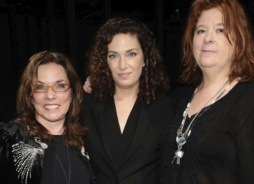
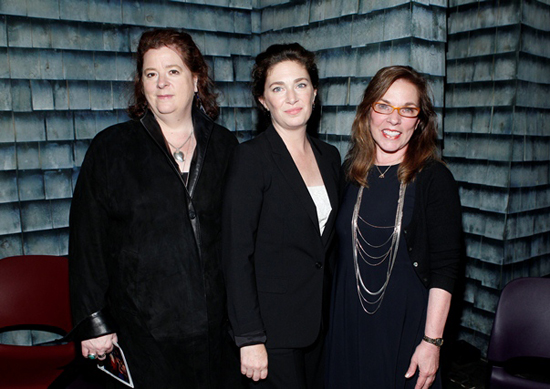
The brainchild of playwright/activists Julia Jordan, Marsha Norman & Teresa Rebeck (pictured above), the Lillies were invented to acknowledge people whose work was consistently overlooked; to right a wrong; to say, “thank you, you rock” to people who make going to the theater worthwhile. And as the awards have moved from their infancy to toddlerhood, they are taking off running, with a swagger, no less, with a character, a style, and panache of their own. They no longer exist as a reaction, but as their own ecosystem, and an annual fete that’s a loud celebration.
The brainchild of playwright/activists Julia Jordan, Marsha Norman & Teresa Rebeck (pictured above), the Lillies were invented to acknowledge people whose work was consistently overlooked; to right a wrong; to say, “thank you, you rock” to people who make going to the theater worthwhile. And as the awards have moved from their infancy to toddlerhood, they are taking off running, with a swagger, no less, with a character, a style, and panache of their own. They no longer exist as a reaction, but as their own ecosystem, and an annual fete that’s a loud celebration.
I sat, a small puddle collecting underneath my seat (from the rain!) closer to stage right, and waited to see who’d be sitting in the semi-circle of chairs onstage, admired the massive bouquets of lilies at either end of the chairs, and waved at and chatted with nearby friends.
The auditorium had looked a bit sparse as we approached the 6 o’clock start, but suddenly blossomed to capacity with damp, happy people.
Then the chairs on the stage filled in, and Teresa welcomed us, and handed us over to Lisa Kron for the Benediction. Lisa is a great American playwright & performer, but she could totally have a side career as a toastmaster. If you’ve ever seen her emcee an event, or give a speech, you won’t forget it, and probably find yourself quoting it the next day.
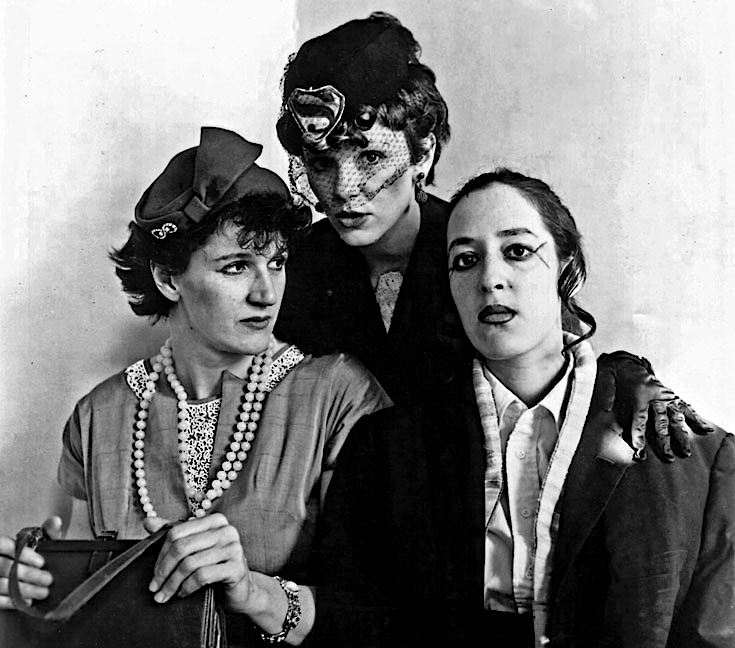
She promised us a moment of despair, some crankiness, and that she would end on a positive note, and delivered on all counts, reminiscing about her college days in which she was deemed a “character actress” which, she said, is code for “lesbian.” Then she came to NYC and recalled seeing the Split Britches company (pictured below): Peggy Shaw, Lois Weaver and Deb Margolin as a moment when her life “pivoted” in a direction it’s followed ever since, and she urged the assembled to challenge institutional thinking, and received wisdom, predicted that one day she might call someone a “dildo,” and concluded with: “Welcome to the Lillies, Amen!”
The auditorium had looked a bit sparse as we approached the 6 o’clock start, but suddenly blossomed to capacity with damp, happy people.
Then the chairs on the stage filled in, and Teresa welcomed us, and handed us over to Lisa Kron for the Benediction. Lisa is a great American playwright & performer, but she could totally have a side career as a toastmaster. If you’ve ever seen her emcee an event, or give a speech, you won’t forget it, and probably find yourself quoting it the next day.
She promised us a moment of despair, some crankiness, and that she would end on a positive note, and delivered on all counts, reminiscing about her college days in which she was deemed a “character actress” which, she said, is code for “lesbian.” Then she came to NYC and recalled seeing the Split Britches company (pictured below): Peggy Shaw, Lois Weaver and Deb Margolin as a moment when her life “pivoted” in a direction it’s followed ever since, and she urged the assembled to challenge institutional thinking, and received wisdom, predicted that one day she might call someone a “dildo,” and concluded with: “Welcome to the Lillies, Amen!”
Julia Jordan gave a brief history of the awards, and the progress in getting mainstream theaters to produce plays written by women. It’s up to around 30%, she reported, though statistics like that, I will point out, are but the tip of the iceberg, and rarely include the huge amount of work by women done by independent theaters and solo artists.
As someone whose work, and the work of most of my friends is produced mostly in independent venues (and frequently self-produced), I appreciate & hope that the rising tide will lift all the boats, but in my world, parity is seen far more often than it is further uptown. Peggy Shaw has never made it to Broadway, but she’s one of the most important and influential artists in American solo and independent theater. Lisa Kron saw her perform at WOW, which still exists, and still incubates new work by women, as do spaces like La Mama (which was mentioned at the Lillies) and Dixon Place and HERE, also founded & run by women (Ellie Covan and Kristin Marting). I’m just saying that looking downtown & across the river yields a garden of wildflowers that complements the Lillies.
Marsha Norman reported that the Lillies are increasing their reach (and grasp) by sponsoring readings of new work, and in this, their fourth year giving out prizes that are “not just medals.”
Then she recounted how, since their founding, many people have helpfully pointed out that Lillian Hellman (the Lilly for whom the awards are named) “didn’t like women,” and indeed there is a famous quote in which Hellman said she was a playwright and a woman, but not a woman playwright. This led to a recurring theme of the event…women talking about how isolating it was to be the only woman in a room full of writers, and comparisons to dogs (used as a metaphor more than once), and led to a goal of the ceremony: Not to apologize for, but to celebrate Lillian Hellman (pictured below).
As someone whose work, and the work of most of my friends is produced mostly in independent venues (and frequently self-produced), I appreciate & hope that the rising tide will lift all the boats, but in my world, parity is seen far more often than it is further uptown. Peggy Shaw has never made it to Broadway, but she’s one of the most important and influential artists in American solo and independent theater. Lisa Kron saw her perform at WOW, which still exists, and still incubates new work by women, as do spaces like La Mama (which was mentioned at the Lillies) and Dixon Place and HERE, also founded & run by women (Ellie Covan and Kristin Marting). I’m just saying that looking downtown & across the river yields a garden of wildflowers that complements the Lillies.
Marsha Norman reported that the Lillies are increasing their reach (and grasp) by sponsoring readings of new work, and in this, their fourth year giving out prizes that are “not just medals.”
Then she recounted how, since their founding, many people have helpfully pointed out that Lillian Hellman (the Lilly for whom the awards are named) “didn’t like women,” and indeed there is a famous quote in which Hellman said she was a playwright and a woman, but not a woman playwright. This led to a recurring theme of the event…women talking about how isolating it was to be the only woman in a room full of writers, and comparisons to dogs (used as a metaphor more than once), and led to a goal of the ceremony: Not to apologize for, but to celebrate Lillian Hellman (pictured below).
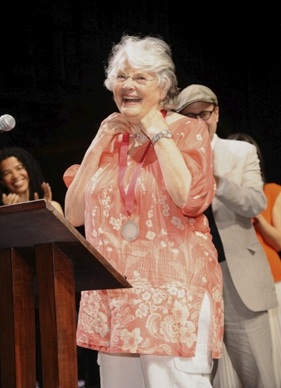
Playwright Neena Beeber came to the stage to present Jessica Hecht the Greta Garbo Award in Acting. Hecht spoke movingly from the point of view of an actor who wants to work with a playwright again and again, and sometimes must wait years between roles before getting a chance to return to collaborate with a fellow artist.
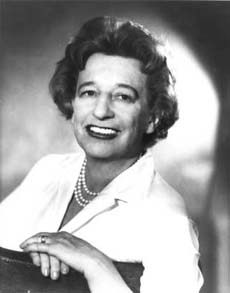
Then actor Terry Kinney, natty in a 3-piece suit and cap, with a lovely blue tie ascended the stage to speak about Lois Smith (pictured above) with great affection and respect, and to present her with a Lifetime Achievement Award for acting. Smith appeared to be taken completely by surprise by the award, but with the aplomb of a great actress (and ordained minister!) she thanked the Lillies and remarked that sometimes the greatest life lesson is “just paying attention.” And she complimented the organizers for “bringing about the change they described.”
Composer/performer/percussionist/sound designer David Van TIghem came to the podium and fooled around with the microphone, because he was there to present the first Seriously Stunning Sound Design award to Jill du Boff. The Lillies have made it a practice to honor the women in the technical, production and management aspects of theater, and this kind of openness, it seems to me, is one of the differences between the closed ecosystem that represents so many awards, and is the difference between “congratulations to us” and “congratulations to us all.”
Then actor Terry Kinney, natty in a 3-piece suit and cap, with a lovely blue tie ascended the stage to speak about Lois Smith (pictured above) with great affection and respect, and to present her with a Lifetime Achievement Award for acting. Smith appeared to be taken completely by surprise by the award, but with the aplomb of a great actress (and ordained minister!) she thanked the Lillies and remarked that sometimes the greatest life lesson is “just paying attention.” And she complimented the organizers for “bringing about the change they described.”
Composer/performer/percussionist/sound designer David Van TIghem came to the podium and fooled around with the microphone, because he was there to present the first Seriously Stunning Sound Design award to Jill du Boff. The Lillies have made it a practice to honor the women in the technical, production and management aspects of theater, and this kind of openness, it seems to me, is one of the differences between the closed ecosystem that represents so many awards, and is the difference between “congratulations to us” and “congratulations to us all.”
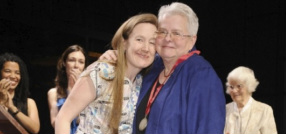
Sarah Ruhl (pictured above, with Paula Vogel), who won the very first Lilly, was then called to the stage to present the latest one to Paula Vogel. She cited just some of Vogel’s achievements, her activism and generosity, told us how she has taught and inspired so many playwrights, and presented her friend and mentor with the beribboned Lilly medal. Vogel addressed Marsha Norman as her own inspiration, for letting her know “that a woman could open the door, AND leave it open for the next one to come through.” She said she feels the theater has become more enriched and deeper because “we’ve learned to love each other” and that her own life has been profoundly changed by the women and men in her workshops, and how much she has learned from their “profound journeys.”
Then Mandy Greenfield of the Manhattan Theatre Club presented the next Lilly to Julie Crosby, artistic director of The Women’s Project & Productions, and Crosby spent a few moments talking about the renaissance of the company, both from an artistic and management standpoint; telling us that in its 35th anniversary season, the theater is “solvent” and that Time/Warner has committed $10,000 per lab artist for their playwrights and directors’ labs, and that Mayor Bloomberg has also become a sponsor. She told us that 84% of the Project’s income goes back to artists.
Which is a huge institutional achievement, and here I am the fly in the ointment, but I will point out that with that kind of support, the Women’s Project should drop the $20 fee it charges to APPLY to its playwrights lab. The fee applies a de facto penalty on women who start out in the American economy making less than men, who may have crushing student loan debt, or a family to support, or who just aren’t lucky enough to have been born middle class, or have somehow lost that status.
I’ve had email exchanges with the people who run the program, in which the responses run along the lines of what you always hear when you argue against charging a playwright a fee to have her work read: well, we have administrative costs. We have to pay the screeners. This is only a fraction of what it costs to run the program…
And as someone who’s worked both in the administrative and receiving end of the non-profit arts, and written plenty of grant proposals, my response is: it’s not the playwrights’ responsibility to fund a program that’s there to develop playwrights for a company that has a mission to develop new work. Like the lottery, submission fees are the equivalent of a “poor people’s tax.”
End of (essential) digression.
Then Mandy Greenfield of the Manhattan Theatre Club presented the next Lilly to Julie Crosby, artistic director of The Women’s Project & Productions, and Crosby spent a few moments talking about the renaissance of the company, both from an artistic and management standpoint; telling us that in its 35th anniversary season, the theater is “solvent” and that Time/Warner has committed $10,000 per lab artist for their playwrights and directors’ labs, and that Mayor Bloomberg has also become a sponsor. She told us that 84% of the Project’s income goes back to artists.
Which is a huge institutional achievement, and here I am the fly in the ointment, but I will point out that with that kind of support, the Women’s Project should drop the $20 fee it charges to APPLY to its playwrights lab. The fee applies a de facto penalty on women who start out in the American economy making less than men, who may have crushing student loan debt, or a family to support, or who just aren’t lucky enough to have been born middle class, or have somehow lost that status.
I’ve had email exchanges with the people who run the program, in which the responses run along the lines of what you always hear when you argue against charging a playwright a fee to have her work read: well, we have administrative costs. We have to pay the screeners. This is only a fraction of what it costs to run the program…
And as someone who’s worked both in the administrative and receiving end of the non-profit arts, and written plenty of grant proposals, my response is: it’s not the playwrights’ responsibility to fund a program that’s there to develop playwrights for a company that has a mission to develop new work. Like the lottery, submission fees are the equivalent of a “poor people’s tax.”
End of (essential) digression.
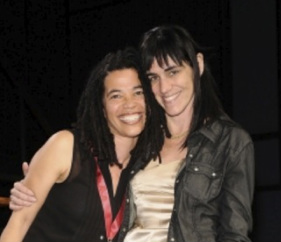
Marsha Norman, with great pride & joy in her former student, presented the next Lilly, the “Welcome to the World” award to Laura Marx, whose play “Bethany,” presented by The Women’s Project, was a much remarked-upon and well-received debut production for her.
The outstanding director Leigh Silverman came up to present a Lilly to Tanya Barfield (both pictured above), for her most recent work, the critically acclaimed “The Call,” which opened on Broadway this spring. The award was fittingly titled: “The Hang in There, It’s the Middle of Your Career, We Need More of Your Plays” award, and was accompanied by one of the “surprises” promised by the organizers.
Teresa Rebeck announced that she’d been approached by producer Stacy Mindich, who wanted to create a commission for a woman playwright. And while Barfield was still standing there, they gave her a a $25,000 commission for her next play. Barfield was overcome with emotion, and the playwright said a few deeply-felt words about her life as a playwright, which includes working a full-time job and raising children, and how much this means to her.
The outstanding director Leigh Silverman came up to present a Lilly to Tanya Barfield (both pictured above), for her most recent work, the critically acclaimed “The Call,” which opened on Broadway this spring. The award was fittingly titled: “The Hang in There, It’s the Middle of Your Career, We Need More of Your Plays” award, and was accompanied by one of the “surprises” promised by the organizers.
Teresa Rebeck announced that she’d been approached by producer Stacy Mindich, who wanted to create a commission for a woman playwright. And while Barfield was still standing there, they gave her a a $25,000 commission for her next play. Barfield was overcome with emotion, and the playwright said a few deeply-felt words about her life as a playwright, which includes working a full-time job and raising children, and how much this means to her.
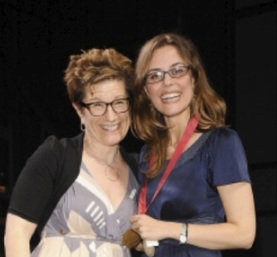
Lisa Kron then asked someone to hand her her wallet…and proceeded to present the next Lilly to director Lear de BIssonet, for her direction of Brecht’s “The Good Person of Szechuan,” which had an ecstatic, sold-out run at La Mama earlier this year, and will move to the Public this fall.
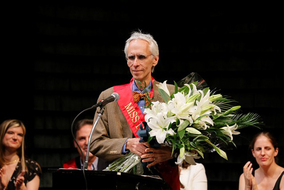
Then came the award that’s become a highlight of the event, which answers the question: “Who is this year’s Miss Lilly?” And the answer was Garry Garrison, director of Creative Affairs for the Dramatists Guild, who donned the traditional sash & tiara, received a bouquet, and was proclaimed an “honorary woman” for his efforts.
Then came the award that’s become a highlight of the event, which answers the question: “Who is this year’s Miss Lilly?” And the answer was Garry Garrison, director of Creative Affairs for the Dramatists Guild, who donned the traditional sash & tiara, received a bouquet, and was proclaimed an “honorary woman” for his efforts.
Then another surprise hit the stage in the form of Cusi Cram, who announced that the Lillies are joining forces with the new prize for women playwrights: the Leah Ryan Fund for Emerging Women Writers. The prize, which is now up to $1,000 and a staged reading of the selected work, was awarded to Jiehae Park, for her play, “Hannah and the Dread Gazebo,” which had its reading on June 4 at Primary Stages.
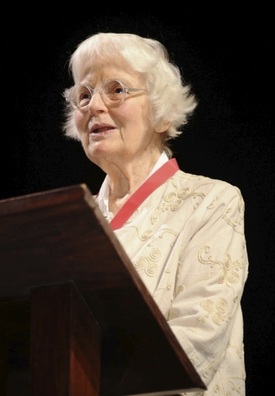
The Lillies then invented themselves again by awarding a special prize to Denise Scott Brown (pictured above), a legendary 81-year-old architect, and husband of the Pritzker Award-winning Robert Venturi, her design partner. In 1991, the Pritzker, the top award for architecture, was given to Venturi alone, though he and Scott Brown had been partners in every way as architects.
Scott Brown’s deliberate exclusion from the prize recently prompted students at Harvard’s School of Design to start an online petition to recognize her for the work she did in partnership with her husband. The petition now has over 13,000 signatures, which Scott Brown noted is “a lot for architecture.” (It’s a lot for theater, too).
Scott Brown then proceeded to give an eloquent talk that’s worthy of a blog post of its own; she immediately connected the treatment she’d received in her career with the “dispossession” that is often felt by women playwrights; she spoke of growing up with an architect for a mother, and how she spent the early part of her career shocked to find out that she was one of the few women in the rooms full of architects. She even wrote an article called “On Sexism and the Star System in Architecture.” She has always gone her own way, she said, and the rewards have been “ecstasy, and my own self-respect.”
Scott Brown’s deliberate exclusion from the prize recently prompted students at Harvard’s School of Design to start an online petition to recognize her for the work she did in partnership with her husband. The petition now has over 13,000 signatures, which Scott Brown noted is “a lot for architecture.” (It’s a lot for theater, too).
Scott Brown then proceeded to give an eloquent talk that’s worthy of a blog post of its own; she immediately connected the treatment she’d received in her career with the “dispossession” that is often felt by women playwrights; she spoke of growing up with an architect for a mother, and how she spent the early part of her career shocked to find out that she was one of the few women in the rooms full of architects. She even wrote an article called “On Sexism and the Star System in Architecture.” She has always gone her own way, she said, and the rewards have been “ecstasy, and my own self-respect.”
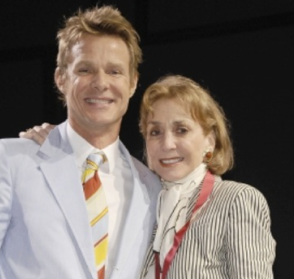
The final award of the program was to another kind of architect: to the woman who created one of the most influential and valuable awards for women playwrights. When Mimi Kilgore (pictured above) lost her sister, Susan Smith Blackburn, she created a Prize in Susan’s honor, which is now given annually to recognize women “who have written works of outstanding quality for the English-speaking theatre,” and which awards $50,000 annually to the Finalists: $25,000 for the top prize, and $25 each to the finalists. In addition, the Winner receives a signed and numbered Willem de Kooning print made especially for the award.
The award was presented to Kilgore by her son, Alex (also pictured), who spoke eloquently of his mother’s dedication to plays written by women, and when she accepted the medal, Kilgore said the award has “given my life a purpose and a strong sense of direction.”
Then all the women in the audience who’d won the prize, been finalists, or served on the board were asked to join the Kilgores onstage, and the amount, range, and diversity of the talent was breathtaking, and the perfect final image to take away from the celebration.
As we slowly made our way across the street for the afterparty, I thought of the work that has moved me recently, and how much of it was made possible by the long walk uphill that so many women and men have taken, that’s still going on, that one day may end at a level playing field.
In the last month (which included a stint at the International Dublin Gay Theatre Festival), I’ve been privileged to see new work from Vickey Curtis, a wonderful Irish playwright & director; the Flux Theatre production of Johnna Adams’s “Sans Merci”; an outstanding solo play, “No Need for Seduction,” written & performed by Victoria Libertore, with a commission from Dixon Place; Mariah McCarthy’s site-specific “Mrs. Mayfield’s Fifth-Grade Class 20th Reunion” produced by Caps Lock Theatre; and the latest version of “The F*cking World According to Molly,” a solo show created by Andrea Alton at the Terranova Collective’s Solo Nova Festival.
This weekend, I'm off to the opening of my play, "Grieving for Genevieve" at the Venus Play Shack in Laurel, MD, an independent thatre that's the brain & love child of Deb Randall...one of the many women who have spent their careers making it possible for women theater artists to have a place, not just in New York, not just in the institutional, mainstream theatre, but in every city, town and village where there's someone willing to look at an empty space and see a stage, stay up nights writing grants for the local arts council, build an audience that knows and wants more work from women.
That put me in mind of people like Staci Swedeen and her Flying Anvil Theater in Knoxville, Dewey Scott-Wiley & Larry Hembree, with Trustus in Columbia, SC, Marj O'Neill Butler and The Women's Theatre Project in Florida..and so many more, more than I could name, which is a good thing. And I won't ever stop trying to find them and thank them (and, of course, send them my work).
We are the Lillies of the Field: see how they grow; we do toil and spin, and we are all the better for it.
The award was presented to Kilgore by her son, Alex (also pictured), who spoke eloquently of his mother’s dedication to plays written by women, and when she accepted the medal, Kilgore said the award has “given my life a purpose and a strong sense of direction.”
Then all the women in the audience who’d won the prize, been finalists, or served on the board were asked to join the Kilgores onstage, and the amount, range, and diversity of the talent was breathtaking, and the perfect final image to take away from the celebration.
As we slowly made our way across the street for the afterparty, I thought of the work that has moved me recently, and how much of it was made possible by the long walk uphill that so many women and men have taken, that’s still going on, that one day may end at a level playing field.
In the last month (which included a stint at the International Dublin Gay Theatre Festival), I’ve been privileged to see new work from Vickey Curtis, a wonderful Irish playwright & director; the Flux Theatre production of Johnna Adams’s “Sans Merci”; an outstanding solo play, “No Need for Seduction,” written & performed by Victoria Libertore, with a commission from Dixon Place; Mariah McCarthy’s site-specific “Mrs. Mayfield’s Fifth-Grade Class 20th Reunion” produced by Caps Lock Theatre; and the latest version of “The F*cking World According to Molly,” a solo show created by Andrea Alton at the Terranova Collective’s Solo Nova Festival.
This weekend, I'm off to the opening of my play, "Grieving for Genevieve" at the Venus Play Shack in Laurel, MD, an independent thatre that's the brain & love child of Deb Randall...one of the many women who have spent their careers making it possible for women theater artists to have a place, not just in New York, not just in the institutional, mainstream theatre, but in every city, town and village where there's someone willing to look at an empty space and see a stage, stay up nights writing grants for the local arts council, build an audience that knows and wants more work from women.
That put me in mind of people like Staci Swedeen and her Flying Anvil Theater in Knoxville, Dewey Scott-Wiley & Larry Hembree, with Trustus in Columbia, SC, Marj O'Neill Butler and The Women's Theatre Project in Florida..and so many more, more than I could name, which is a good thing. And I won't ever stop trying to find them and thank them (and, of course, send them my work).
We are the Lillies of the Field: see how they grow; we do toil and spin, and we are all the better for it.
 RSS Feed
